Collision Plate Type Supersonic Jet Mill Model CPY
Collision-Plate-Type pulverization with the No.1 crushing power in the industry

Principle
Principle for CPY with classifier DSF
CPY Part
- Pulverization is performed through the particles collide with the collision plate in a air flow of theoretically over Mach 2.
- Circulate the coarse particles to the pulverization zone again
DSF Part
- Disperses the particles by the vortex flow in the upper dispersion zone.
- Evenly supplies the particles from the ring shaped slit into the classification zone.
- The secondary air, provided from the guide vane, forms a high speed vortex flow.
- High precision separation of the coarse particles and the fine particles is enabled by the vortex flow.
Principle for CPY with classifier UFS
CPY Part
- Pulverization is performed through the particles collide with the collision plate in a air flow of theoretically over Mach 2.
- Circulate the coarse particles to the pulverization zone again
UFS Part
- Disperse and supply material powder from the guide vane with a high speed air flow.
- The high speed vortex flow separates the coarse particles in the 1st classification zone.
- The fine particles are separated from the ultra fine particles in the 2nd classification zone.
- Highly efficient classification is enabled by repeated classification in the 1st classification zone and the 2nd classification zone.
Features
Features for CPY with classifier DSF
- Every particle collides with the target plate.
- High-efficiency pulverization is enabled by the large impact force.
- Pulverizes the material powder of high hardness, which was conventionally impossible to pulverize.
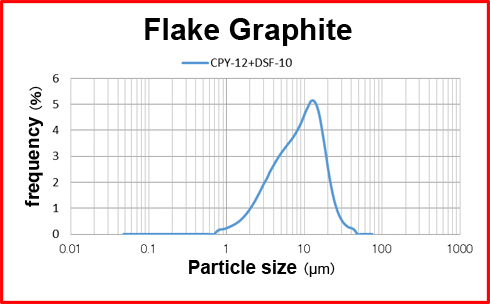
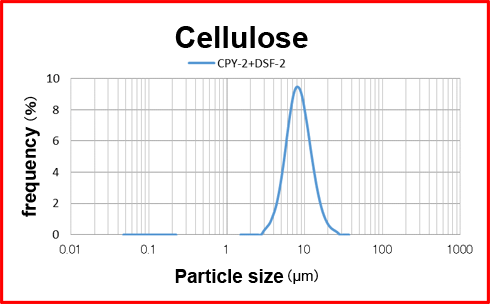
- The pulverized particles of a narrow particle size distribution can be obtained.
Features for CPY with classifier UFS
- Processing efficiency significantly increased with application of the special grinding nozzle and the target plate.
- High-efficiency pulverization is enabled by the large impact force.
- Easy maintenance due to the simple structure.
- Space-saving design (50% less compared with the previous model)
Specification
Specification for CPY with classifier DSF
| Model |
Comp. air consumption [Nm³/min] |
Compressor power [kW] |
Blower power [kW] |
Comp. air supply port diameter [-] |
Weight [kg] |
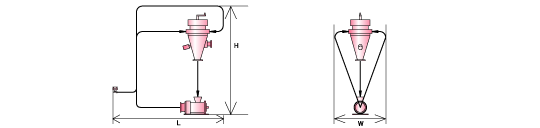
Outside Dimension [L×W×H mm] |
||
| CPY-2+DSF-2 | 2 | 15 | 3.7 | G 3/4 | 97 | 750 | 430 | 1145 |
| CPY-5+DSF-5 | 5 | 37 | 18.5 | G1 | 171 | 920 | 525 | 1960 |
| CPY-12+DSF-10 | 12 | 75 | 30 |
JIS10K 50A Flange |
308 | 1060 | 700 | 2950 |
| CPY-20+DSF-20 | 20 | 125 | 55 |
JIS10K 80A Flange |
809 | 1290 | 950 | 3020 |
Specification for CPY with classifier UFS
| Model |
Comp. air consumption [Nm³/min] |
Compressor power [kW] |
Blower power [kW] |
Comp. air supply port diameter [-] |
Weight [kg] |
Outside dimension [L×W×H mm] |
||
| CPY-2+UFS-2 | 2 | 15 | 7.5 | G 3/4 | 139 | 850 | 550 | 1450 |
| CPY-5+UFS-5 | 5 | 37 | 37 | G1 | 223 | 1040 | 740 | 1750 |
| CPY-12+UFS-10 | 12 | 75 | 55 |
JIS10K 50A |
259 | 1170 | 1450 | 2415 |
Optional Specification
Specification for CPY with classifier DSF
| 1. | Antifriction specification | The materials of high hardness or elastic-resinous surface coating on the powder contacting parts can be applied. |
| 2. | Adhesion resistant specification | Surface coating with a material of low coefficient of friction on the powder contacting parts can be applied. |
| 3. | Remote control louver specification | The particle size can be easily altered during operation by just adjusting the dial. |
| 4. |
Ultra fine pulverization specification (FAS・N Type Casing) |
Capable to provide the still finer particles. |
Specification for CPY with classifier UFS
| 1. | Antifriction specification | The materials of high hardness or elastic-resinous surface coating on the powder contacting parts can be applied. |
| 2. | Adhesion resistant specification | Surface coating with a material of low coefficient of friction on the powder contacting parts can be applied. |
Application Examples
Application Examples for CPY with classifier DSF