Dispersion Separator Model DXF
The Standard Model for Ultra Fine Classification
Principle
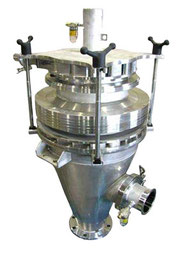
- Completely disperses the particles in the vortex flow, which is created by the 1st guide vane in the dispersion zone.
- Evenly supplies the particles from the ring shaped slit into the separate zone.
- The secondary air, provided from the 2nd guide vane, forms a high-speed vortex flow.
- The vortex flow enables separation of the coarse and fine particles with high precision.
Features
- The 1st guide vanes in the dispersion zone allow high dispersion of raw material agglomerates.
- Very low contamination of fine product in coarse product due to uniformity and high dispersibility.
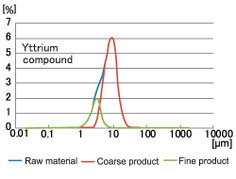
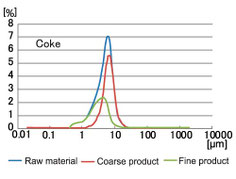
- High classification accuracy even in the fine product range (D75/D25=1.1~1.3) .
- Classification point can be set as required (1-50μm) .
- No moving parts, making anti-abrasion and anti-adhesion measures easy, and highly effective on very sticky raw materials.
- Simple structure for easy maintenance checkup and parts replacement.
Specifications
| Model |
Flow rate [Nm³/min] |
Blower power [kW] |
Intake port diameter [-] |
Exhaust port diameter [-] |
Weight [kg] |
| DXF-2 | 4 | 3.7 |
25A Ferrule |
50A Ferrule |
71 |
| DXF-5 | 10 | 18.5 |
40A Ferrule |
90A Ferrule |
132 |
| DXF-10 | 20 | 30.0 |
40A Ferrule |
150A Ferrule |
252 |
| DXF-20 | 40 | 55.0 |
65A Ferrule |
200A JIS5K Flange |
410 |
Optional Specifications
| 1. | Antifriction specification | The materials of high hardness or elastic-resinous surface coating on the powder contacting parts can be applied. |
| 2. | Adhesion resistant specification | Surface coating with a material of low coefficient of friction on the powder contacting parts can be applied. |
Application Examples